


Product overview
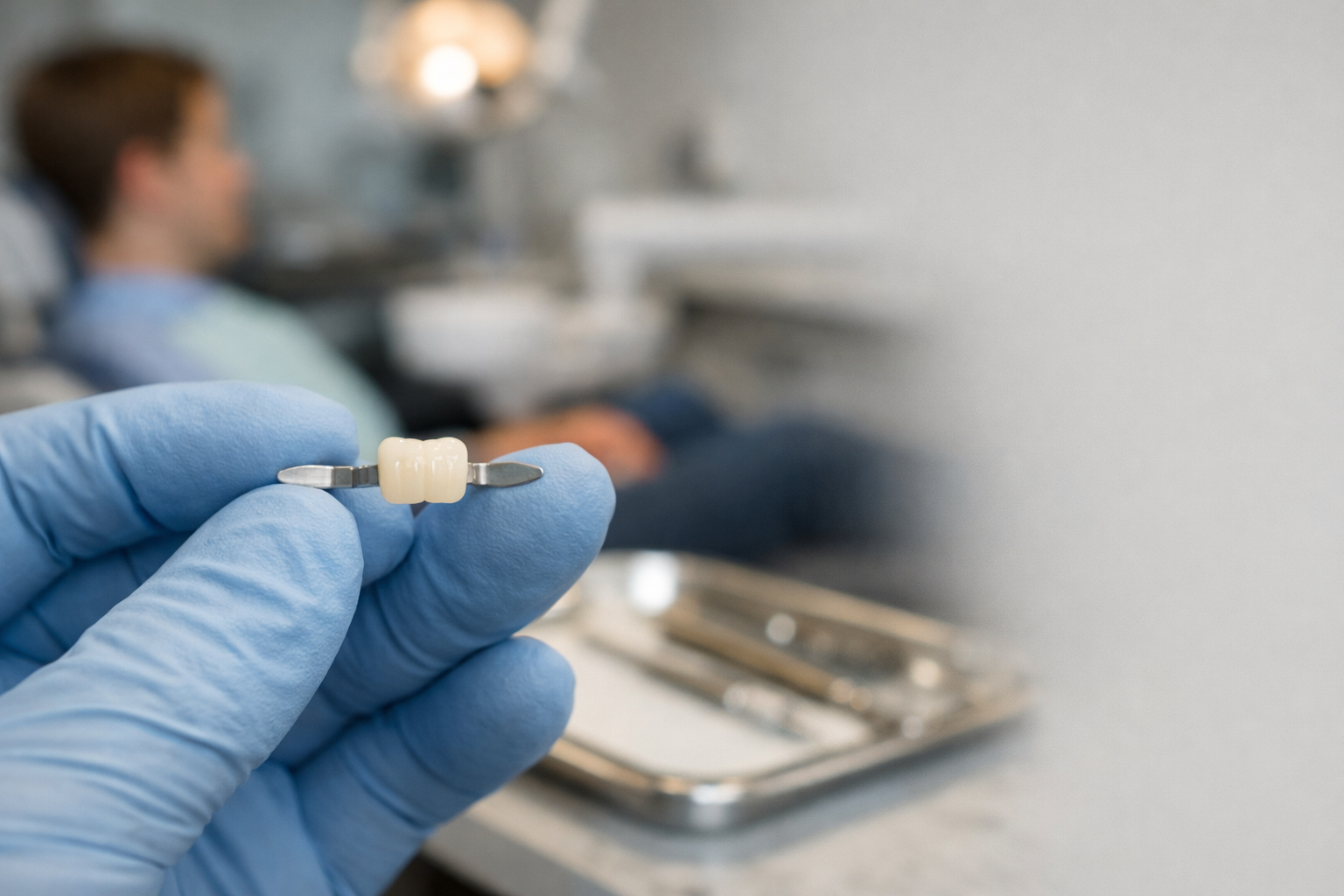
The Maryland Bonded Bridge (also called a resin-bonded bridge or Maryland bridge) is one of the most conservative fixed dental restorations available. Unlike a traditional bridge that requires permanently grinding down adjacent healthy teeth, the Maryland bridge uses thin metal or ceramic wings that bond directly to the back (lingual surface) of the neighbouring teeth — requiring little to no tooth preparation at all.
Originally developed at the University of Maryland in the 1970s, this technique has been refined significantly with modern zirconia and e.max ceramic frameworks and stronger resin bonding cements – making today’s Maryland bridges both highly aesthetic and reliably durable for anterior (front) tooth replacement.
No tooth drilling
Wings bond to the back of adjacent teeth — healthy enamel is fully preserved with zero preparation needed.
Fast treatment
Completed in just 1–2 dental visits over 1–2 weeks – no surgery, no healing period required.
Natural aesthetics
All-ceramic zirconia framework and pontic shade-matched to surrounding teeth – metal-free and invisible.
What is a Maryland bonded bridge?
Definition & concept
A Maryland bonded bridge is a fixed prosthetic device used to replace a single missing tooth, typically in the front of the mouth. It consists of three parts: a pontic (the artificial replacement tooth in the centre) and two retainer wings – thin extensions on each side that are bonded with dental adhesive to the inner (back) surfaces of the neighbouring teeth called abutments.
Because the wings attach to the lingual (tongue-facing) surfaces, they are completely invisible from the front. The abutment teeth require little to no enamel removal – making this one of the most tooth-conserving fixed restorations in modern dentistry.
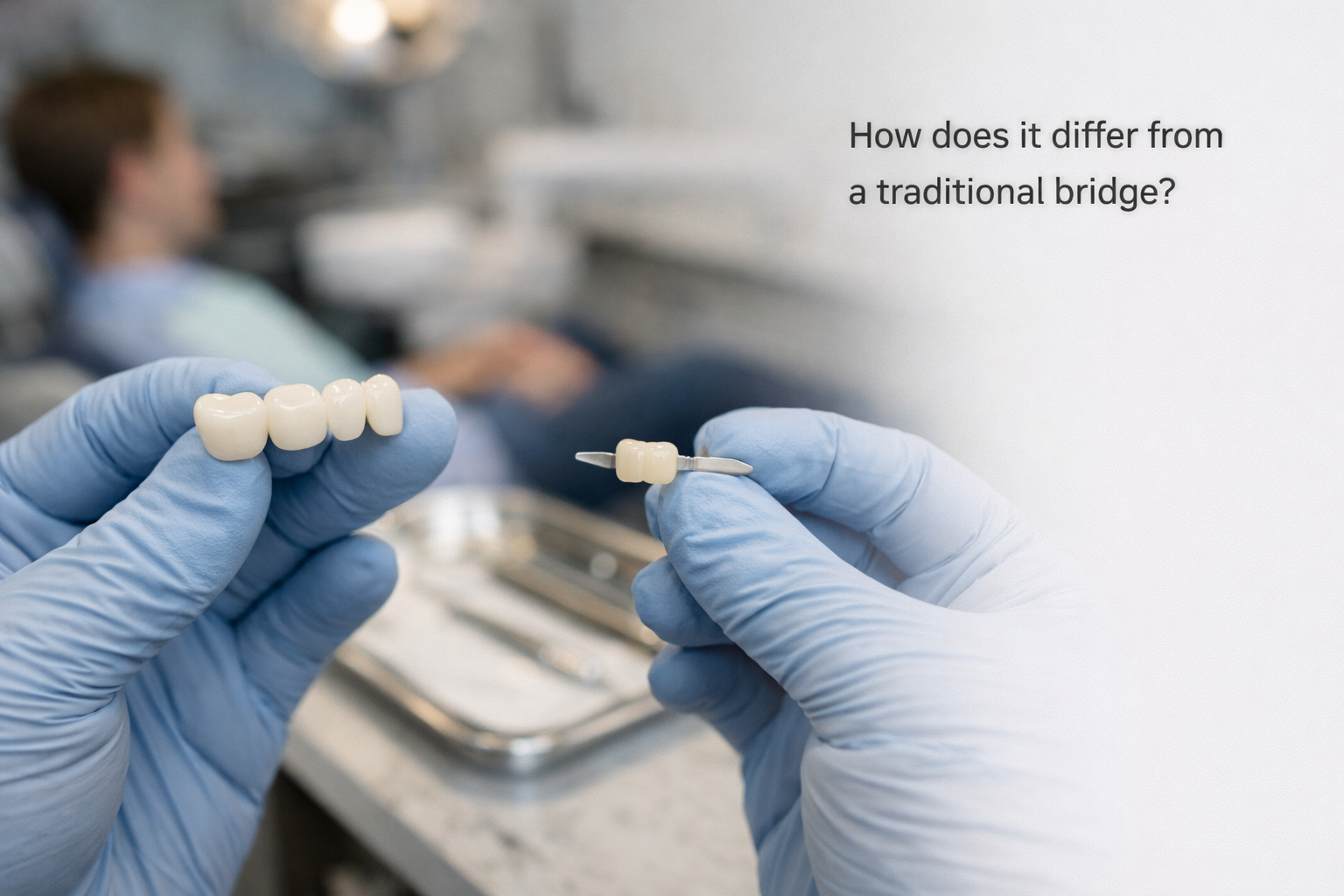
How does it differ from a traditional bridge?
A traditional bridge requires grinding the full circumference of both adjacent teeth into stumps to accommodate crowns on each side. This permanently destroys healthy enamel that can never be restored. The Maryland bridge takes a far more conservative approach:
- Adjacent teeth require no or minimal preparation - enamel is preserved
- The pontic is held in place by thin ceramic or metal wings bonded to the lingual surfaces
- Completely reversible - the bridge can be debonded without damaging the teeth if needed
- Faster and more comfortable - no injections, no drilling, no temporaries in most cases
- Ideal for younger patients whose teeth and jaws are still fully developed
Types of Maryland bonded bridges
Maryland bridges are available in different framework materials. The right choice depends on aesthetics, bite, and the position of the missing tooth.
Zirconia Maryland bridge
Zirconia Maryland bridge
The most popular modern option. Fully metal-free, tooth-coloured wings and pontic. Extremely strong and completely invisible from front or back.
Cost: $1,800–$2,500 | Life: 10–15 yrs
e.max (lithium disilicate)
Pressed ceramic offering superior translucency. Ideal for upper front teeth needing the most lifelike appearance. Bonded with resin cement.
Cost: $1,700–$2,300 | Life: 8–12 yrs
Metal-ceramic (traditional)
Original Maryland bridge design with cast metal wings and porcelain pontic. Very strong retention but metal wings may be visible on translucent teeth.
Cost: $1,500–$2,000 | Life: 7–12 yrs
Single-wing (cantilever) Maryland bridge
Uses only one retainer wing bonded to a single abutment tooth. Reduces stress on the bonded tooth and is preferred by many clinicians for its improved long-term success rate over two-wing designs.
Best for: Upper lateral incisors, single anterior gaps
Two-wing Maryland bridge
The classic design with wings on both sides of the pontic. Provides maximum stability. More commonly used when the gap has healthy teeth on both sides with adequate lingual surface area for bonding.
Best for: Patients with strong enamel on both abutments
Key features & specifications
| Feature | Details |
|---|---|
| Product name | Maryland Bonded Bridge - Resin-Bonded Fixed Prosthesis |
| Framework material | Zirconia, e.max (lithium disilicate), or metal alloy |
| Pontic material | Zirconia or ceramic (shade-matched) |
| Wing design | Single-wing (cantilever) or two-wing |
| Tooth preparation | None to minimal (micro-etching of enamel only) |
| Cementation | High-strength resin adhesive cement (e.g. Panavia) |
| Shade system | VITA Classical A1–D4 / VITA 3D-Master |
| Fabrication method | CAD/CAM milling - 5-axis precision |
| Fit accuracy | Marginal gap ≤ 80 microns |
| Reversibility | Removable / debondable without tooth damage |
| Biocompatibility | ISO 10993-certified, metal-free options available |
| Warranty | 2 years against manufacturing defects |
Procedure - step by step
What happens during Maryland bridge treatment?
The Maryland bridge procedure is one of the quickest fixed restorations in dentistry — typically completed in 2 visits over 1–2 weeks, often with no anaesthesia needed.
1. Consultation & clinical assessment
Your dentist evaluates the gap, the health of adjacent teeth, your bite, and the available lingual surface area for wing bonding. They confirm a Maryland bridge is suitable and select the best material and wing design for your case.
2. Minimal tooth preparation (if any)
In most cases, no drilling is needed. The dentist may lightly etch or roughen a small area of enamel on the back of the abutment teeth using a micro-abrasion technique to improve bonding adhesion — no anaesthetic required.
3. Digital impression or intraoral scan
A precise digital scan captures the exact shape of your teeth, the gap, and your bite. This data is used by the dental laboratory to design and fabricate the bridge to a perfect fit.
4. Laboratory fabrication (1–2 weeks)
The Maryland bridge is CAD/CAM milled from a solid block of zirconia or pressed from e.max ceramic. The shade is matched to your natural teeth and the wings are shaped to fit precisely against the lingual surfaces of the abutments.
5. Try-in & shade verification
The bridge is placed in the mouth without cement to check the fit, shade match, and bite. Adjustments are made chairside to ensure perfect aesthetics and comfort before bonding.
6. Permanent bonding & cementation
The abutment tooth surfaces are cleaned and conditioned. The bridge wings are etched and coated with high-strength resin cement (such as Panavia). The bridge is pressed firmly into place and the cement is light-cured to harden instantly.
7. Bite check & follow-up
The bite is verified and any excess cement is removed. A follow-up appointment at 2–4 weeks assesses the bridge stability, gum health around the pontic, and the integrity of the resin bond.
Care & maintenance
How to care for your Maryland bonded bridge
With proper care, a zirconia Maryland bridge can last 10–15 years. The most important factor is protecting the resin bond at the wing interface and maintaining healthy gums around the pontic.
Daily hygiene
- Brush twice daily with a soft-bristle toothbrush and non-abrasive fluoride toothpaste
- Use floss threaders or superfloss to clean under the pontic - this area is prone to plaque build-up
- A water flosser is highly recommended for flushing debris from under the bridge pontic
- Use an antimicrobial mouthwash daily to keep gum tissue around the pontic healthy
Foods and habits to avoid
- Avoid biting into very hard foods (crusty bread, apples, raw carrots) directly with the bridge
- Avoid sticky foods - toffee, chewing gum, and caramel can stress or dislodge the resin bond
- Do not use your teeth as tools - opening packaging or biting nails can loosen the wing
- If you grind your teeth at night, wear a custom night guard to protect the bond from excessive force
Regular dental visits
Visit your dentist every 6 months for professional cleaning and to check the integrity of the resin bond, the fit of the wings, and the health of the gum tissue beneath the pontic. If a wing feels loose, contact your dentist promptly – early re-bonding prevents complete detachment.
Frequently asked questions
1. Does getting a Maryland bridge require any injections or drilling?
Ans. In the vast majority of cases, no anaesthesia and no drilling are required. The procedure involves only a light etching of the enamel surface on the back of the adjacent teeth – a completely painless step. This makes the Maryland bridge one of the most comfortable dental procedures available.
2. How long does a Maryland bonded bridge last?
Ans. With good care, a zirconia Maryland bridge typically lasts 10–15 years. Metal-ceramic versions average 7–12 years. The most common reason for replacement is debonding of a wing rather than failure of the pontic itself. Debonded wings can often be re-cemented quickly and cost-effectively.
3. Can a Maryland bridge fall off?
Ans. Wing debonding is the most common complication – occurring in roughly 10–20% of cases over 10 years. It is more likely with a two-wing design under heavy bite force. Modern single-wing (cantilever) designs and improved resin cements have significantly improved retention. If a wing debonds, it can almost always be re-bonded at a single visit.
4. Is a Maryland bridge better than a dental implant?
Ans. They serve different situations. A dental implant is the gold standard – it preserves bone, lasts a lifetime, and functions exactly like a natural tooth. A Maryland bridge is better suited for patients who want to avoid surgery, have insufficient bone for an implant, are younger with still-developing jaws, or need a faster and more affordable solution. Many patients use a Maryland bridge as an interim restoration while planning for an implant later.
5. What teeth can a Maryland bridge replace?
Ans. Maryland bridges work best for front teeth – most commonly upper central and lateral incisors, lower incisors, and upper canines. They are generally not recommended for premolars or molars where bite forces are high, as the resin bond may not withstand the sustained chewing pressure in back teeth areas.

