Secure Dental Data Management

Understanding how your dental clinic collects, stores, and protects your personal data is your right as a patient — and a sign of a clinic that takes your trust seriously.

Introduction

Trust begins with transparency

Every time you visit a dental clinic, you share something personal — your health history, your X-rays, your contact details, even your insurance information. For many patients, the question is natural: where does all of this go, and who can see it?

This guide answers those questions plainly. You will learn exactly why clinics collect information, what responsible data management looks like, and what to look for when choosing a clinic that truly values your privacy.

Why Dental Clinics Collect Your Information

Data collected to serve you — not to track you

Every piece of information a dental clinic collects has a clear clinical purpose. None of it is gathered out of habit or convenience — it is there to ensure your treatment is safe, effective, and personalised.

Clinics need your information to understand your medical background before any treatment, to communicate with labs and specialists involved in your care, to maintain accurate records required by healthcare regulation, and to track your oral health as it evolves over time.

What Kind of Data is Stored

A complete picture of your oral health

Modern dental records are detailed and multi-layered. The table below shows what a typical clinic keeps on file, and why each category is necessary.

Data type What it includes
Personal details Name, date of birth, address, contact information, and insurance data
Medical history Existing conditions, current medications, allergies, and past surgeries
Treatment records Every procedure performed, prescriptions issued, and clinical notes made
Digital X-rays & scans High-resolution images archived with timestamps and dentist annotations
Lab reports Test results and fabrication specs shared securely between dentist and dental lab
Referral records Clinical summaries and imaging shared with specialists or hospitals when needed

Why Data Security Matters

Medical records are among the most sensitive data that exists

Unlike a leaked password, you cannot change your health history. Dental and medical records contain information that is deeply personal — and in the wrong hands, can be misused in ways that affect your finances, insurance coverage, and overall wellbeing.

Strong data security is not just good practice — for healthcare providers, it is a legal and ethical obligation. Patients deserve to know their information is handled with the same care as the treatment itself.

How Clinics Keep Your Data Safe

Multiple layers of protection

Responsible dental clinics do not rely on a single safeguard. Data security works in layers — each one adding another barrier between your records and any potential threat.

End-to-end encryption All records — X-rays, notes, reports — are encrypted in transit and at rest, making them unreadable without proper authorisation.
Role-based access control Each staff member can only access data relevant to their role. A receptionist cannot view clinical notes; a lab technician cannot access billing records.
Secure cloud storage Patient records stored on compliant, regularly audited cloud platforms with automated backups — protecting against hardware failures and data loss.
Audit logs Every access to a patient record is timestamped and logged — who viewed it, when, and why — creating a full accountability trail.
Staff training Regular training ensures every team member understands data handling responsibilities and how to identify phishing attempts or accidental disclosures.
Secure sharing with labs When X-rays or reports must be shared with a dental lab or specialist, they are transmitted via encrypted, authenticated channels — never open email or physical media.

Risks of Poor Data Security

What happens when security falls short

Poor data management is not just a regulatory problem — it has real consequences for patients. Understanding the risks makes clear why choosing the right clinic matters.

HIGH RISK

Identity theft. Personal and insurance details stolen from dental records can be used fraudulently to claim benefits or open financial accounts in your name.

SERIOUS

Medical record tampering. If records are not secured, errors — accidental or deliberate — can affect future treatment decisions and lead to incorrect diagnoses.

MODERATE

Unauthorised disclosure. Sensitive health information shared without consent can affect insurance premiums, employment opportunities, or simply violate your right to privacy.

MODERATE

Data loss. Without proper backups, X-rays and treatment history can be permanently lost — disrupting continuity of care if you change clinics or need emergency treatment.

What Patients Should Know

Your rights and what to ask

As a patient, you have rights over your own data — and you should feel empowered to exercise them. Here is what every patient should know before and during their time at a dental clinic:

1.You can request your records. Any accredited clinic must provide you with access to your full dental records upon request.

2.Ask about data policies. A trustworthy clinic will clearly explain how your data is stored, who can access it, and how long it is kept.

3.Consent is required. Your data cannot be shared with third parties — including labs or specialists — without your knowledge and consent.

4.You can request corrections. If any record contains an error, you have the right to request it be updated or annotated.

5.Look for compliance signals. Ask whether the clinic follows applicable healthcare data regulations and whether systems are regularly audited.

6.Report concerns. If you suspect your data has been mishandled, you have the right to lodge a complaint with your data protection authority.

Real-Life Examples

What good data security looks like in practice

SECURE STORAGE OF X-RAYS AND REPORTS

Your imaging archive — protected and portable

Digital X-rays are encrypted and stored in secure, cloud-based practice management systems. Only treating dentists and authorised staff can access them. When you move to a new clinic, records can be transferred securely — not handed over on a USB or printed and posted.

SAFE SHARING BETWEEN DENTIST AND LAB

What happens when your data leaves the clinic

When a crown or aligner needs to be fabricated, your dentist must share impressions, X-rays, or digital scans with a dental laboratory. In a secure clinic, this is done via encrypted file transfer or a dedicated clinical portal — never through open email. The lab sees only what it needs, and the transfer is logged.

Conclusion

Choose a clinic that earns your trust

Data security is not a background technical detail — it is a core part of what it means for a dental clinic to care for its patients properly. The same professionalism that shows in clinical excellence should show equally in how your personal information is treated.

When you choose a clinic that is transparent about its data practices, invests in modern security infrastructure, and respects your rights as a patient, you are not just protecting your information — you are choosing a practice that takes its duty of care seriously in every dimension.
Digital Transformation in Dentistry

Modern technology is transforming the way your smile is cared for — making visits faster, more comfortable, and more precise than ever before.

Introduction

A new era for your smile

If your last dental memory involves a messy impression tray, a mouth full of putty, and a long wait for results — things have changed dramatically. Today’s dental clinics are powered by digital tools that make every part of your visit smarter, smoother, and more comfortable.

This guide explains what digital dentistry means, how it benefits you, and why visiting a modern dental clinic could completely change your perspective on oral healthcare.

What is Digital Dentistry?

Technology, in simple terms

Digital dentistry refers to the use of computer-based technologies to replace or improve traditional dental tools and processes. Think of it as swapping old film cameras for high-resolution digital ones — except for your teeth.

From the moment you sit in the chair to when you walk out with a finished crown, digital tools are at work behind the scenes — and often right in front of you on a screen.

How Dental Visits Have Changed

Then vs. now

Not long ago, a routine dental procedure could mean multiple appointments, unpleasant impression materials, weeks of waiting for lab-fabricated restorations, and X-rays that exposed patients to relatively higher radiation. For many patients, this made dental anxiety significantly worse.

BEFORE

Uncomfortable, slow, and imprecise

Patients bit down on trays filled with impression material and waited 2–3 weeks for a crown. Discomfort, gagging, and multiple visits were common — and errors in the impression often meant starting all over again.

TODAY

Fast, comfortable, and highly accurate

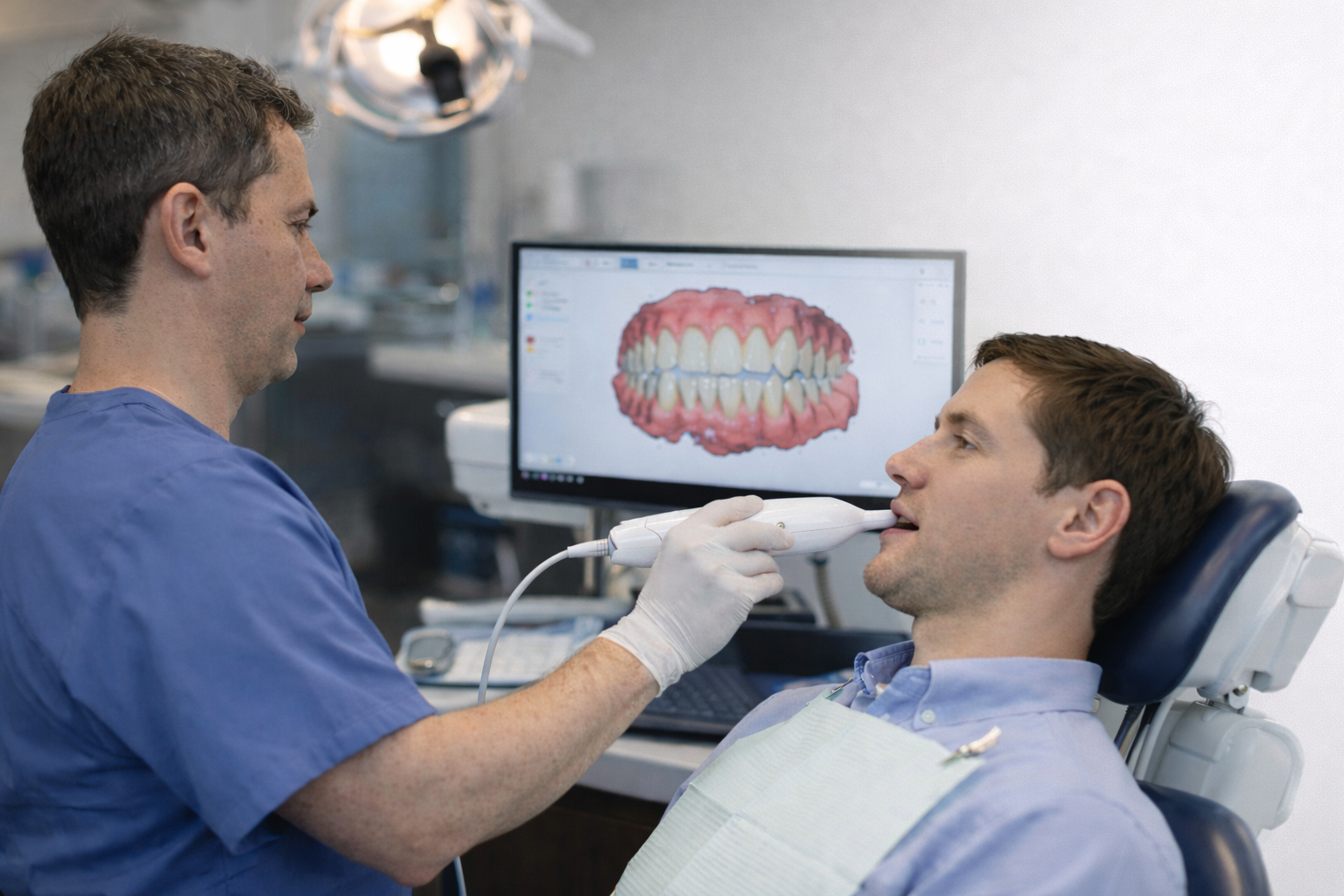
A small handheld scanner creates a precise 3D digital map of your mouth in minutes. No trays, no putty, no gagging. Software designs the restoration, and in many cases it is ready the same day — while you wait.

Modern Technologies Used in Clinics

Tools shaping your experience

Modern clinics now use a range of interconnected technologies that work together to improve every step of your treatment.

Technology What it does for you
Intraoral Scanner A small wand captures thousands of images per second to build a precise 3D model of your teeth — no messy molds, no gagging.
Cone Beam CT (3D X-ray) Produces detailed 3D images of your jaw, roots, and nerves — far more informative than traditional flat X-rays and with greater safety.
CAD/CAM Milling Computer-aided design and manufacturing creates crowns, veneers, and bridges in-house — often within a single hour.
Digital X-rays Instantly produce crystal-clear images with up to 90% less radiation than traditional film X-rays.
Smile Design Software Preview and approve how veneers or alignment treatments will look on your actual face before anything is done.
Laser Dentistry Lasers treat gum disease, remove decay, and perform procedures with minimal bleeding and faster healing.

Benefits for Patients

What this means for you

  • Less pain and discomfort.Digital scanners eliminate impression trays that trigger gag reflexes. Laser tools reduce the need for drills and stitches. Many procedures that once required anaesthesia are now far more tolerable.
  • Faster treatments.What previously took two or three separate appointments can often be completed in a single visit. Same-day crowns, instant digital records, and in-house milling mean you spend less time in the chair.
  • Better accuracy and outcomes.Digital impressions have error rates far lower than manual ones. 3D imaging lets your dentist plan implants, extractions, and orthodontics with submillimetre precision — reducing complications and the need for revisions.
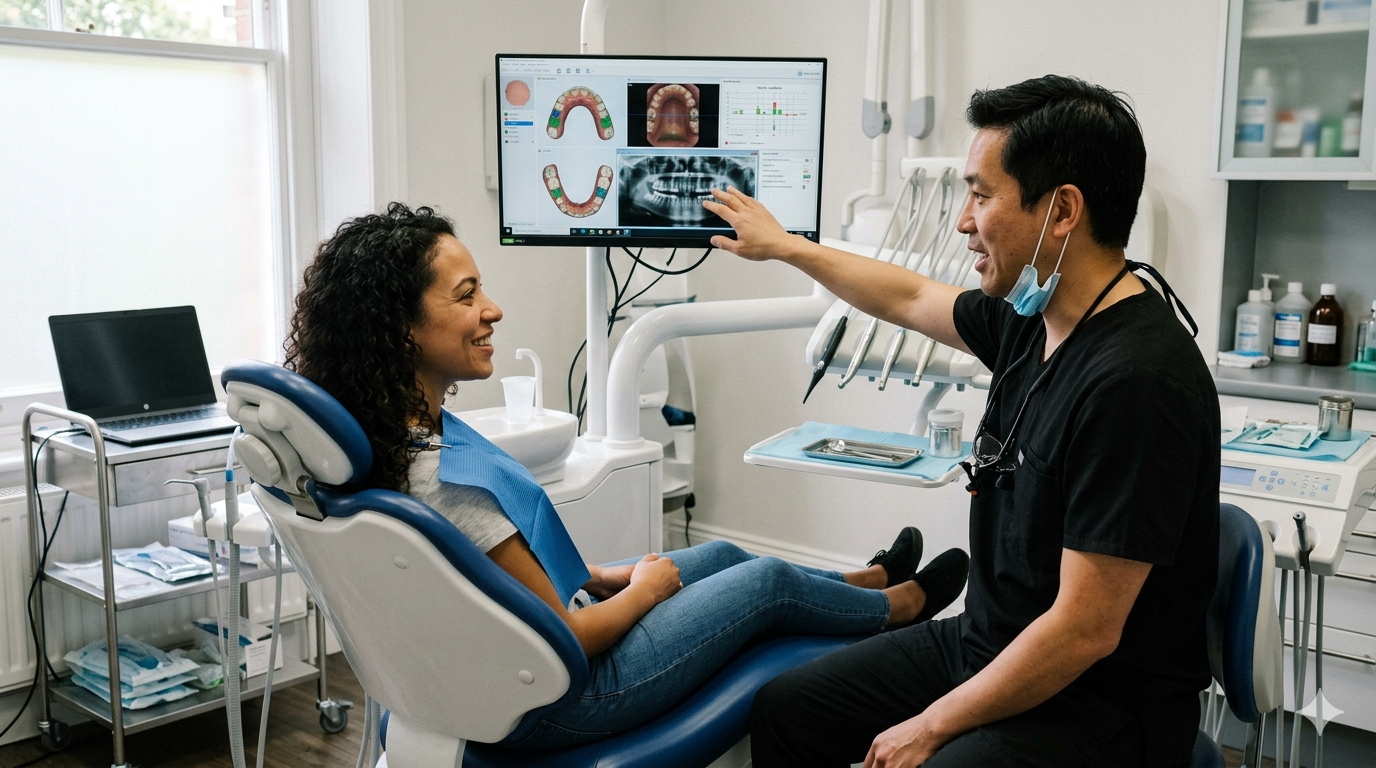
  • Transparency and trust.When your dentist can show you your own 3D scan on a screen and walk through the treatment plan visually, it builds understanding — and genuine confidence in the process.

Real-Life Examples

Seeing the difference in practice

SAME-DAY CROWNS

No more temporary crowns or two-week waits

With CAD/CAM technology, your dentist scans your tooth, designs a perfect-fit ceramic crown digitally, mills it on-site, and bonds it in place — all within a single appointment. There is no temporary crown, no return visit, and no lab delays.

DIGITAL IMPRESSIONS FOR ALIGNERS

Goodbye to putty trays forever

Orthodontic treatment used to begin with uncomfortable trays filled with putty pressed against your teeth. Today, a quick intraoral scan takes around five minutes and gives the lab a more accurate model than any physical impression could. Your clear aligners are designed and manufactured directly from that digital file.

DIGITAL SMILE DESIGN

See your new smile before committing

Planning veneers or a smile makeover? Software overlays the proposed changes onto photos or 3D scans of your face so you can see the result before a single tooth is touched. Adjustments are made digitally — not on you.

Is Digital Dentistry Safe?

Tried, tested, and trusted

Digital dentistry is not experimental — these technologies have been developed, clinically tested, and refined over decades. They are regulated by dental and medical authorities worldwide and are used by millions of patients every year.

  • Digital X-rays emit significantly less radiation than traditional X-rays — making routine imaging safer and more frequent when needed.
  • Intraoral scanners are non-invasive, non-contact devices that are thoroughly sterilised between patients.
  • CAD/CAM-milled ceramic restorations are made from materials with a long track record of biocompatibility and durability.
  • All digital systems are operated by trained dental professionals — the technology assists expertise, it does not replace it.

Conclusion

Your next visit, reimagined

Digital dentistry is not a distant promise — it is happening right now in modern clinics. From the moment you open wide for a scan to the moment you leave with a same-day restoration, technology is working to make your experience genuinely better.

Whether you are anxious about dental visits, pressed for time, or simply want the best care available, choosing a digitally equipped practice is one of the most meaningful decisions you can make for your oral health.

Patient Education Guide

Every visit you make to the dentist generates information. Learn how modern clinics use that information — safely and intelligently — to give you care that is built around you.

Introduction

More than just teeth — your complete dental story

When you visit a dentist, more happens than a cleaning or a check-up. Every appointment builds a richer picture of your oral health over time. X-rays, notes, treatment history, and health questionnaires all come together to form something valuable: a personalised dataset that helps your dentist understand you better with every visit.

Data-driven dentistry means putting that information to work — not just filing it away, but actively using it to improve how you are diagnosed and treated.

What is Data-Driven Dentistry?

Intelligence that improves with every visit

At its core, data-driven dentistry means using collected patient information — records, scans, history, and measurements — to guide clinical decisions. Instead of relying solely on what a dentist sees in a single appointment, they can look at trends, patterns, and changes over time.

What Kind of Information Dentists Use

Your dental record, explained

A typical patient profile at a modern clinic contains far more than you might expect. Here is a glimpse of what a data-driven dentist has access to:

Sample patient record — Arjun Kulkarni

Patient since 2019 · Last visit: 3 months ago

Medical history Mild hypertension, no allergies
Past treatments 2× fillings, Scaling, Root canal (2022)
X-ray archive 14 digital scans on file (2019–2024)
Gum health trend Pocket depth stable at 2–3mm
Risk flags Early enamel wear noted
Next recommended Fluoride treatment + bite guard assessment

This kind of longitudinal record lets a dentist notice things that would be invisible in a one-off visit — like a slow-developing cavity, a gradual shift in bite alignment, or a pattern of gum inflammation that signals future risk.

How This Helps Your Treatment

From raw records to real decisions

Data does not help patients on its own — it is the interpretation that matters. Here is how a dentist turns your information into a treatment plan tailored to you:

  • Records collectedEach visit adds data
  • Patterns analysedTrends spotted over time
  • Plan personalisedTreatment fits your needs
  • Better outcomesFewer surprises, less pain

Benefits for Patients

What it means for your care

01 More accurate diagnosis

Comparing current scans to years of archived images means small changes are caught early — before they become expensive problems.

02 Personalised care

Your treatment is shaped by your history, risks, and lifestyle — not a generic protocol applied to every patient equally.

03 Better long-term results

Preventive care guided by data reduces the likelihood of major interventions. Regular monitoring keeps your oral health on track over years.

Real-Life Examples

Data in action

TRACKING PAST TREATMENTS

A dentist who knows your history does not start from zero

When your records show that a particular filling was placed five years ago in a tooth that now has sensitivity, your dentist can check that restoration first — rather than guessing or ordering unnecessary tests. That is time saved, money saved, and discomfort avoided.

PLANNING BRACES OR IMPLANTS

Precision planning with your full picture

For orthodontic treatment, a dentist with years of jaw development data can predict how your teeth will move more reliably. For implants, 3D imaging combined with bone density records means the placement is planned down to the millimetre — reducing surgical risk and improving long-term success rates.

RISK PREVENTION

Catching what cannot be seen in a single visit

A patient whose gum pocket depth has been increasing by 0.5mm per year might look perfectly healthy at any individual appointment. Only by comparing records over time does the pattern — and the risk of periodontitis — become visible. Data makes this possible.

Is My Data Safe?

Your privacy is protected

Patient data in dental clinics is governed by strict medical privacy regulations. Modern clinics use encrypted digital systems, access controls, and secure cloud storage to ensure your records remain confidential.

  • Your dental records are protected under healthcare privacy laws and can only be accessed by authorised clinical staff.
  • Digital records are encrypted and stored on secure, regularly backed-up systems — far safer than paper files.
  • You have the right to access, review, and request corrections to your dental records at any time.
  • Data is never sold or shared with third parties without your explicit consent.

Conclusion

The dentist who truly knows you

The best dental care is not reactive — it is informed. Every check-up you attend, every scan that is taken, and every note your dentist records builds a more complete understanding of your oral health. Over time, this becomes one of the most valuable assets in your healthcare journey.

Regular visits to a data-driven clinic do not just fix problems — they help prevent them, personalise your care, and give you and your dentist a shared, accurate picture of your health across years.