

Table Of Contents
Every visit you make to the dentist generates information. Learn how modern clinics use that information — safely and intelligently — to give you care that is built around you.
Introduction
More than just teeth — your complete dental story
When you visit a dentist, more happens than a cleaning or a check-up. Every appointment builds a richer picture of your oral health over time. X-rays, notes, treatment history, and health questionnaires all come together to form something valuable: a personalised dataset that helps your dentist understand you better with every visit.
Data-driven dentistry means putting that information to work — not just filing it away, but actively using it to improve how you are diagnosed and treated.
What is Data-Driven Dentistry?
Intelligence that improves with every visit
At its core, data-driven dentistry means using collected patient information — records, scans, history, and measurements — to guide clinical decisions. Instead of relying solely on what a dentist sees in a single appointment, they can look at trends, patterns, and changes over time.
What Kind of Information Dentists Use
Your dental record, explained
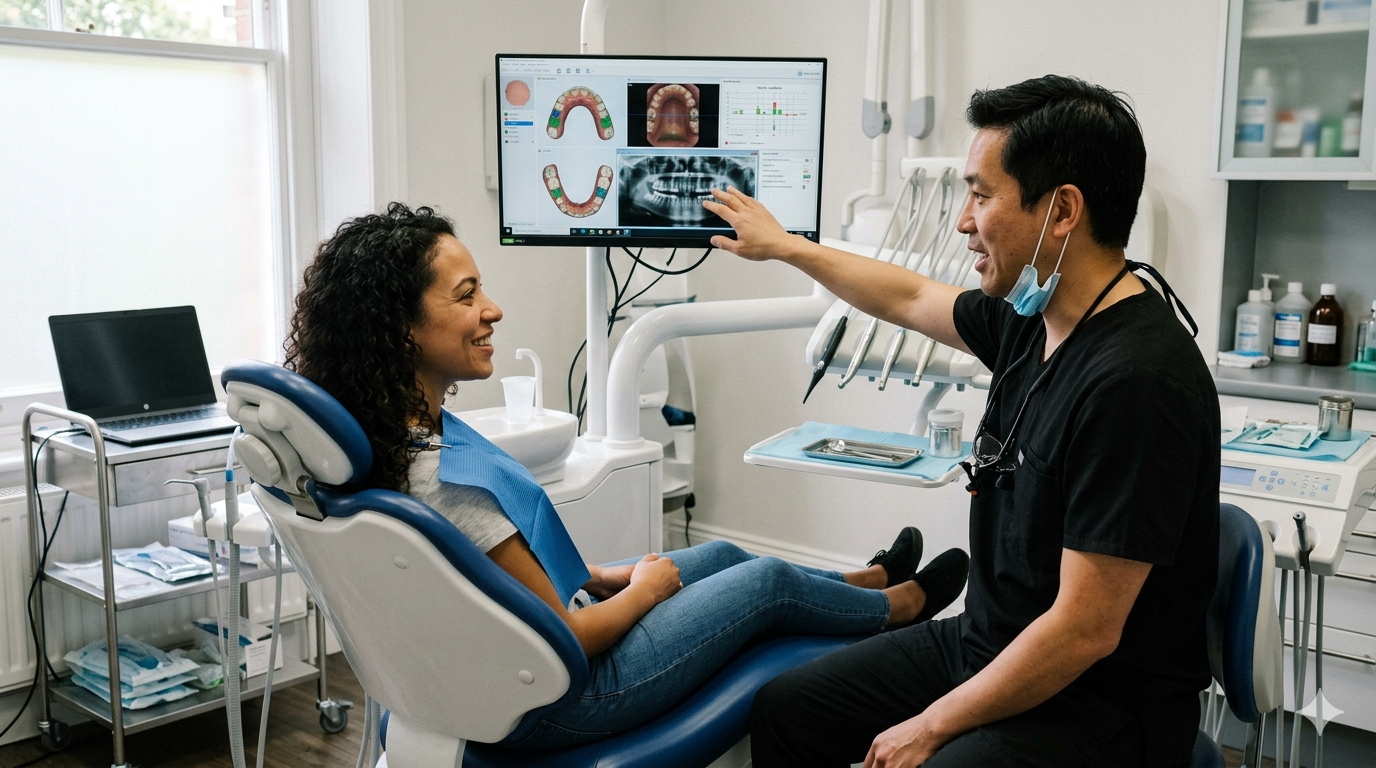
A typical patient profile at a modern clinic contains far more than you might expect. Here is a glimpse of what a data-driven dentist has access to:
Sample patient record — Arjun Kulkarni
Patient since 2019 · Last visit: 3 months ago
| Medical history | Mild hypertension, no allergies |
| Past treatments | 2× fillings, Scaling, Root canal (2022) |
| X-ray archive | 14 digital scans on file (2019–2024) |
| Gum health trend | Pocket depth stable at 2–3mm |
| Risk flags | Early enamel wear noted |
| Next recommended | Fluoride treatment + bite guard assessment |
This kind of longitudinal record lets a dentist notice things that would be invisible in a one-off visit — like a slow-developing cavity, a gradual shift in bite alignment, or a pattern of gum inflammation that signals future risk.
How This Helps Your Treatment
From raw records to real decisions
Data does not help patients on its own — it is the interpretation that matters. Here is how a dentist turns your information into a treatment plan tailored to you:
- Records collectedEach visit adds data
- Patterns analysedTrends spotted over time
- Plan personalisedTreatment fits your needs
- Better outcomesFewer surprises, less pain
Benefits for Patients
What it means for your care
01 More accurate diagnosis
Comparing current scans to years of archived images means small changes are caught early — before they become expensive problems.
02 Personalised care
Your treatment is shaped by your history, risks, and lifestyle — not a generic protocol applied to every patient equally.
03 Better long-term results
Preventive care guided by data reduces the likelihood of major interventions. Regular monitoring keeps your oral health on track over years.
Real-Life Examples
Data in action
TRACKING PAST TREATMENTS
A dentist who knows your history does not start from zero
When your records show that a particular filling was placed five years ago in a tooth that now has sensitivity, your dentist can check that restoration first — rather than guessing or ordering unnecessary tests. That is time saved, money saved, and discomfort avoided.
PLANNING BRACES OR IMPLANTS
Precision planning with your full picture
For orthodontic treatment, a dentist with years of jaw development data can predict how your teeth will move more reliably. For implants, 3D imaging combined with bone density records means the placement is planned down to the millimetre — reducing surgical risk and improving long-term success rates.
RISK PREVENTION
Catching what cannot be seen in a single visit
A patient whose gum pocket depth has been increasing by 0.5mm per year might look perfectly healthy at any individual appointment. Only by comparing records over time does the pattern — and the risk of periodontitis — become visible. Data makes this possible.
Is My Data Safe?
Your privacy is protected
Patient data in dental clinics is governed by strict medical privacy regulations. Modern clinics use encrypted digital systems, access controls, and secure cloud storage to ensure your records remain confidential.
- Your dental records are protected under healthcare privacy laws and can only be accessed by authorised clinical staff.
- Digital records are encrypted and stored on secure, regularly backed-up systems — far safer than paper files.
- You have the right to access, review, and request corrections to your dental records at any time.
- Data is never sold or shared with third parties without your explicit consent.
Conclusion
The dentist who truly knows you
The best dental care is not reactive — it is informed. Every check-up you attend, every scan that is taken, and every note your dentist records builds a more complete understanding of your oral health. Over time, this becomes one of the most valuable assets in your healthcare journey.
Regular visits to a data-driven clinic do not just fix problems — they help prevent them, personalise your care, and give you and your dentist a shared, accurate picture of your health across years.

